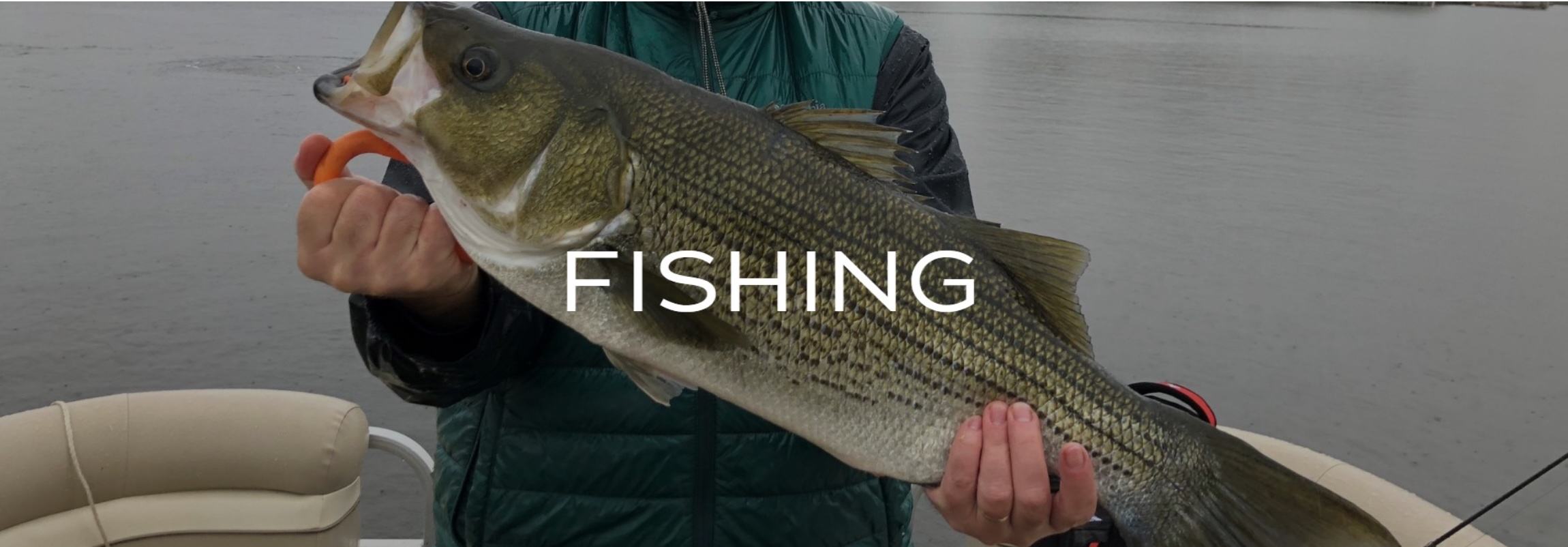
West Shores is a private lake that is owned, stocked and maintained by the West Shores Home Owners Association, Inc. Pursuant to Article I of our Lake Rules: "A guest must be accompanied by the [Association] member or a resident member of the family when using any of the common areas (that is, the lake)." Guest boats are prohibited as they present a serious risk of invasive species contamination.
Important Updates
05/09/2022: Electroshocking survey completed and the collected rough fish were disposed. Twelve species were identified, consisting of game fish: largemouth bass, bluegill, white and black crappie, walleye, wiper and catfish, as well as rough fish: river carpsucker, buffalo, long & short nosed gar, common carp and gizzard shad.
12/20/2020: Lake Habitat & Health Committee announces revised walleye limit of 2 day / 4 possession per lot in the 15" to 19" slot. Catch and release all walleye above or below the slot. Limits on other species shown below.
Fishing Regulations
West Shores is a private lake that is owned, stocked and maintained by the West Shores Home Owners Association, Inc. Pursuant to Article I of our Lake Rules: "A guest must be accompanied by the [Association] member or a resident member of the family when using any of the common areas (that is, the lake)." Guest boats are prohibited as they present a serious risk of invasive species contamination.
Trespassers may be reported to the Douglas County Sheriff and cited for criminal trespassing, a second degree misdemeanor under NRS 28-521, the penalties for which are set forth in NRS 28-106.
Since the lake has outflow that reaches the Elkhorn river, Nebraska state regulations relating to fishing, including licensure and daily catch limits (per day/possession), are applicable. The West Shores Lake Habitat & Health Committee recommends that daily catch limits be applied on a per lot basis (see limits per fish species below). Additional fish identification tips can be found on the Wikipedia links.
Game fish are fish pursued by recreational anglers. The term can refer to freshwater or saltwater fish. Game fish can be eaten after being caught. The species of fish pursued by anglers varies with geography. Some fish are sought for their value as food, while others are pursued for their fighting abilities or for the difficulty of pursuit.
Big-game fish are bony saltwater fish such as tuna, tarpon, and billfish (sailfish, marlin and swordfish). In North America, anglers fish also for common snook, redfish, salmon, trout, bass, pike, catfish of several species, walleye, and muskellunge.
The smallest fish routinely sought by anglers are called panfish, because they can fit in a normal cooking pan. Examples are crappies, perch, rock bass, bluegills, and other sunfish. Panfish are often sought by younger anglers, at least partly due to the relative ease with which they can be caught.
White Crappie & Black Crappie
Daily catch limit is 15 per lot per day and the possession limit (includes your freezer) is 30 per lot. White and Black Crappie are catch and release until after spring spawn (May 10). White crappie are also known as Goldring and Silver Perch.
Walleye
Daily catch limit is 2 per lot per day and the possession limit (includes your freezer) is 4 per lot for Walleye in the 15-19" slot, measured tip of nose to tip of tail, so catch & release for less than 15" or greater than 19". Walleye are also called yellow pike. The name comes from the fact that the fish's eyes point outward, as if looking at the walls. West Shores stocks Walleye annually.
Bluegill
Catch & release only. The bluegill are sometimes referred to as "bream", "brim", "sunny", or "copper nose" and are a member of the sunfish family. Bluegills can grow up to 12 inches long and about 4 1/2 pounds. They typically have a very distinctive coloring, with deep blue and purple on the face and gill cover, dark olive-colored bands down the side, and a fiery orange to yellow belly. The fish play a key role in the food chain, and are prey for bass, other sunfish, northern pike, walleye, and muskies. West Shores stocks these fish most years.
Largemouth Bass
Catch & release only. Largemouth Bass is known by a variety of regional names, such as the widemouth bass, bigmouth bass, black bass, bucketmouth, largies, Potter's fish, Florida bass, Florida largemouth, green bass, bucketmouth bass, Green trout, gilsdorf bass, Oswego bass, LMB, and southern largemouth and (paradoxically) northern largemouth.
Hybrid Striped Bass aka Wiper
Catch & release only. The Hybrid Striped Bass, also known as a Wiper or Whiterock Bass, is a hybrid between the Striped Bass and the White Bass. It can be distinguished from the Striped Bass by broken rather than solid horizontal stripes on the body. West Shores stocks these fish in some years.
Tiger Muskie
Catch & release only. Tiger Muskellunge are a sterile hybrid cross between Northern Pike and Muskellunge. It has a very elongated torpedo-like body. Its most notable feature is the grey-green vertical bars along its sides. West Shores stocked 100 of these fish in 2019.
Channel Catfish
Channel Catfish daily catch limit is 5/20, however, please observe this on a per lot basis.
Catch & Release
Please watch this great, short video on proper Catch and Release techniques.
Rough Fish
Rough fish (or the slang trash fish or dirt fish) is a term used by U.S. state agencies and U.S. anglers to describe fish that are less desirable to sport anglers within a limited region. The term usually refers to larger fish species that are not commonly eaten, are too rare to be commonly encountered, or are not sought by anglers for sporting purposes.
Carp are classified as a rough fish and should always be removed from the lake and disposed of appropriately.
Drum are classified as a rough fish and should always be removed from the lake and disposed of appropriately.
Goldeneye, also known as Skipjack Shad, are classified as a rough fish and should always be removed from the lake and disposed of appropriately.
Shortnose Gar are classified as a rough fish and should always be removed from the lake and disposed of appropriately. BE CAREFUL NOT TO CONFUSE GAR WITH TIGER MUSKIE.
Longnose Gar are classified as a rough fish and should always be removed from the lake and disposed of appropriately.